
Literacy & Numeracy Screening
Screening results will be sent out in accordance to Microsoft email maximum limitations. This may result in a delay receiving your child's report. We thank you for your patience.
The Government of Alberta requires school divisions to conduct literacy and numeracy screening with students in kindergarten through to grade 5. The purpose of screening is to help identify learning needs early and ensure students receive appropriate support when needed. FSD is required to administer these screenings, share results with families, and provide interventions when screening results indicate a student may need additional support.
What is Literacy and Numeracy Screening?
Literacy and numeracy screening is part of Alberta Education and Childcare's provincial approach to supporting student success. These assessments help identify students who may benefit from additional support in reading, writing, language development, mathematics, and number sense.
The screenings are not graded tests and are not used for report card marks. They are intended to provide information that helps educators respond to student learning needs.
What does this look like in FSD schools?
As the screenings are a provincial requirement, Foothills School Division has worked these required screenings into its established assessment and reporting schedule (view our System of Reporting). Schools work closely with families to support student success.
Schools use screening results alongside classroom observations, assessments, and ongoing learning evidence to determine the most appropriate supports for each student. Additional supports may include targeted literacy or numeracy interventions, differentiated instruction, or other learning strategies. FSD has invested intervention staff and professional learning to support students identified through the provincial screening process.
What Can Parents Expect?
- Information about when screening will occur.
- Communication about their child's results.
- Follow-up conversations if additional supports are recommended.
- Ongoing updates about their child's progress.
A screening result is only one source of information about a student's learning and does not define a child's abilities or future success.
Frequently Asked Questions
No. Students do not need to study for these assessments. This is a snapshot of student learning that helps teachers better understand strengths and areas of need.
The screeners are structured to be progressive, allowing for consistent measures as the child progresses in the school year and through grade levels. The provincial screeners are norm-referenced, meaning a student’s performance is compared with a representative group of Alberta students in the same grade at that point in the school year. This information helps determine whether a student may, or may not, require additional support.
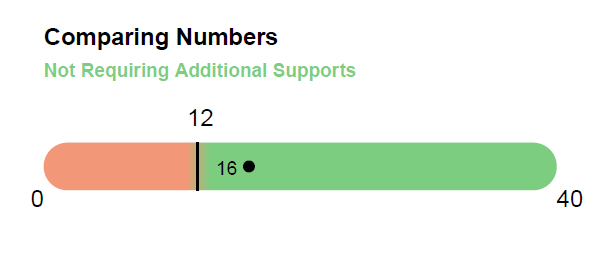
- Number to the right of the chart: total number of possible questions
- Solid line: the "Norm" for that assessment area. This is the average result for Alberta students of the same grade level and time of year
- Data point "dot": the individual student's measure for this assessment area
Examples:
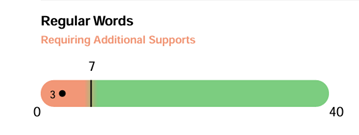 |  | |
Regular Words The chart above shows the child requiring additional support in this assessment area.
3 is below the norm of 7, which indicates the child requires additional supports. | Comparing Numbers The chart above shows the child not requiring additional support in this assessment area.
16 is above the norm of 12, which indicates the child does not require additional supports. |
Screening information helps teachers determine where additional attention and support may be needed. The provincial requirements specify that intervention supports are to be provided when screening indicates that a student is may be experiencing difficulty in literacy or numeracy
This does not automatically mean additional staffing or additional government-funded support for an individual student. Rather, schools use their existing continuum of supports which may include:
- Universal classroom strategies to support all students in a common area for growth
- Small group instruction with the teacher or in centers with an Educational Assistant
- Literacy or numeracy intervention groups
- One on one targeted practice with an adult
No. Screening results provide one piece of information about your child’s learning.
Teachers also consider classroom work, observations, conversations and ongoing assessments to develop a more complete picture of each child’s strengths, progress and learning needs.
You do not need to recreate school at home. The best way to support your child is through simple, positive literacy and numeracy experiences as part of everyday life. Short, enjoyable opportunities to read, talk, write, count and problem-solve together can reinforce the foundational skills students are developing at school.
Some ideas include:
- Read together regularly.
Talk about the story, characters, new vocabulary and what your child thinks might happen next. - Play with sounds and words.
Rhyming, noticing beginning sounds, breaking words into sounds or syllables, and playing word games can help build early literacy skills. - Encourage writing.
Grocery lists, notes, cards, labels, journals and stories are all meaningful opportunities to practice. - Make math part of everyday life.
Count objects, compare quantities, notice patterns, practice simple mental math, measure while cooking, talk about time and money, or play games involving numbers and dice. - Ask your child to explain their thinking.
Questions such as “How did you figure that out?” or“ Is there another way you could solve it?” help build understanding and confidence. - Keep it positive.
Encourage effort, curiosity and perseverance rather than focusing on scores or whether an answer is right or wrong.
Alberta Education and Childcare has developed a parent guide with additional information about literacy and numeracy screening for English and French Immersion students.
Please scroll down to review the Parent Guide: Literacy and Numeracy Screening or visit Alberta.ca to learn more.
